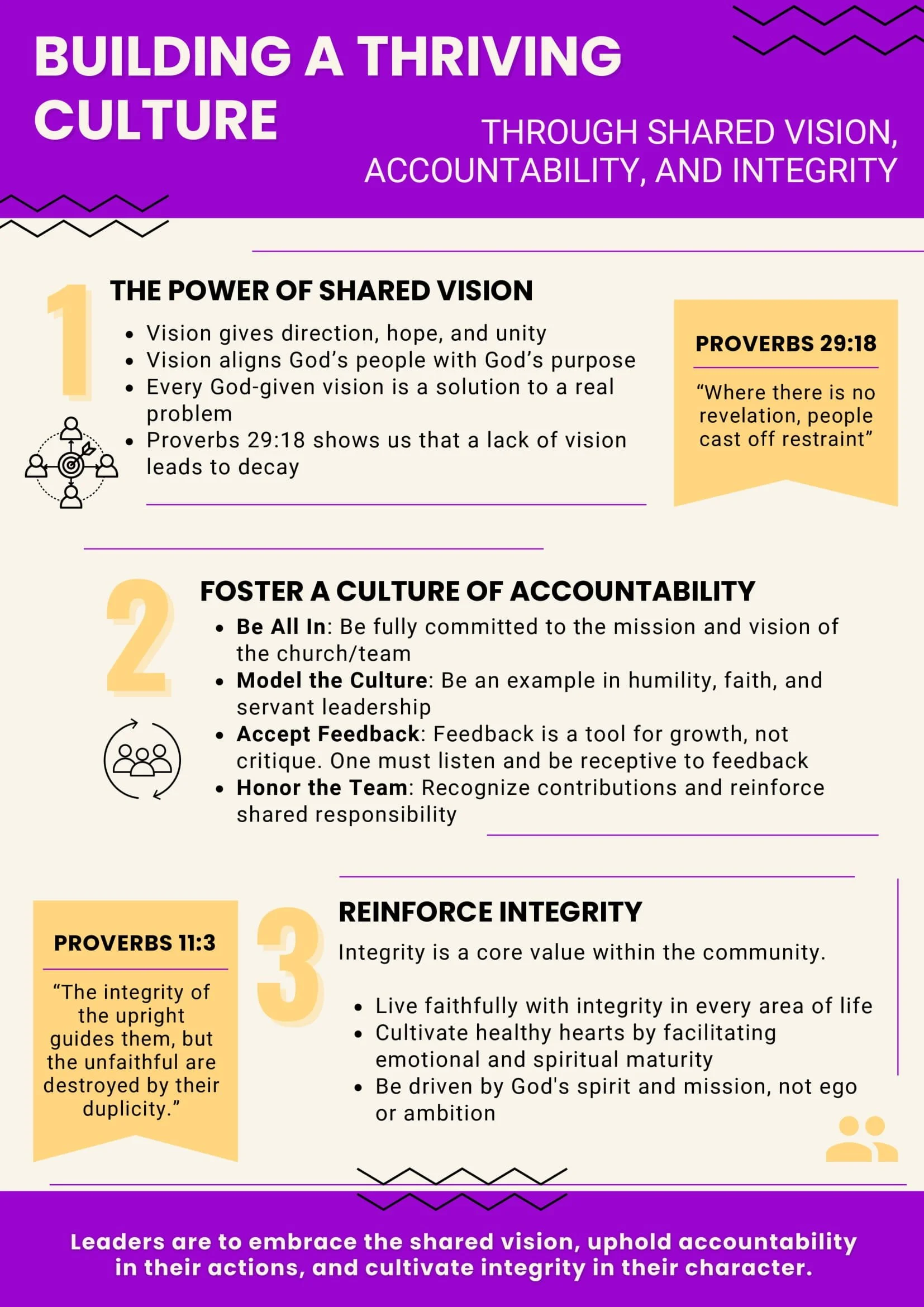
Building a Thriving Culture: Shared Vision, Accountability, and Integrity
A Pastor or team leader should consistently share an organization’s culture, reinforcing who we are and what we do. I think sometimes people can get lost in the concept of culture because they believe that upper leadership shapes it. Well, I’m going to tell you right now…nicely…that you are incorrect.
Who knows who actually shapes an organization's culture? Let me see…. if you guessed you, me, us, or we, then you are absolutely correct! Top leaders may decide how they want the organization to look and function, but it is up to us, leaders and the general body, to reinforce culture through our behaviors and actions towards each other in our roles and responsibilities. I am speaking to you all individually here. Even myself.
While I have the mic and spotlight, I’m going to remind you that a shared vision, accountability, and integrity shape healthy, mission-driven communities and a thriving organizational culture.
Key Scriptures:
Proverbs 29:18 - “Where there is no revelation, the people perish.”
It can be easy to forget the bigger picture when we get bogged down in tasks and day-to-day activities. I’m sure many of us are carrying heavy plates and balancing many things that may make you choose a priority. When you start to lose sight of the goal or focus, remembering the shared vision will motivate you.
The Power of Shared Vision
A vision is important to any group. It is the guiding principle for what you do today and how it may impact tomorrow. It is a collective statement and agreement of passion for the mission and values that guide the group. The mission tells what we want to do. The vision is where we want to go.
Why Vision Matters - Key Points
Vision gives direction, hope, and unity. Without vision, people and organizations drift into irrelevance or dysfunction. When engaged in strategic planning for our ministries, we should use the vision as a steering principle. Which leads to the next point.
Vision aligns God’s people with God’s purpose. Visions can be the end goal or a solution to an everlasting problem.
Every God-given vision is a solution to a real problem. A prime example of this is Nehemiah’s vision to rebuild the walls of Jerusalem. If you recall, Nehemiah waited months for God to present a solution to the pain he felt for Jerusalem. With that vision, who knows how long it would have been before the walls were rebuilt.
Understanding the vision is one thing, but we must also be able to communicate it to others and get them to see the action.
To do so, we must consistently communicate and reinforce the vision. Don’t assume people know the direction or can see the problem—describe it with spiritual clarity and clear language. We must clarify and simplify.
The second imperative to making vision stick is to cast it convincingly. We must communicate it in a way that moves people to action!!! Engage people in the life and mission of our culture by connecting their roles to the larger mission. Connect the vision to God’s bigger purpose. People follow vision when it connects to their calling and God’s glory.
Don’t just describe what is; show what could be and should be from God’s perspective. Leaders must embody the vision to give people hope and a picture of what God wants to do.
Fostering a Culture of Accountability
We all know what accountability is. It is taking ownership of our responsibilities and commitments to each other and the mission. When we volunteer or commit to something, it should be from our hearts. Serving should not feel like a burden or a responsibility in which you can give the bare minimum. It is the duty and responsibility of every Christian to edify the church and others.
Let’s be frank, we are all adults and should be able to hold ourselves accountable for what we do and what we believe in. Beyond that, we should be grateful that others are willing to hold us accountable. It facilitates growth. So, how should or could one be accountable for themselves?
Key Points:
Be All In – Be fully committed to the mission, your team, role, and tasks. Again, this goes beyond giving the bare minimum. Or even serving and volunteering because you “have to” not want to. Believe it or not, this is reflected in your attitude and actions.
Next, Model the Culture: Being a living example is the best way to exemplify Christianity. I’m sure we all know people who have been turned off or turned off from religion because of how they act. Be an example in humility, fun, faith, and servant leadership. You must talk the talk and walk the walk. On and off the screen.
Build Feedback Loops: Use feedback as a tool for growth, not critique. We are all on a growth journey. The only way to improve our service and services is by listening to feedback. If this were a sport, you would listen to your coach and teammates. Why not your pastor and siblings in Christ?
Honor the Team: Recognize contributions and reinforce shared responsibility. Thank your team and give credit where it is due.
Proverbs 11:3 - “The integrity of the upright guides them, but the unfaithful are destroyed by their duplicity.”
Emphasizing Integrity
Last, we have the trait of integrity. Integrity is living in alignment with biblical values, both in public and private. This means you are authentic to who you are in every situation.
Key Points: Integrity is a core value within the community. We don’t want anyone to present faces when interacting with OCC.
Live Faithfully – Integrity in every area of life. Who you are at home should mirror who you are at church and work.
Cultivate Healthy Hearts – Emotional and spiritual maturity.
Be Driven by God's Spirit – Not ego or ambition. We should seek to serve others not ourselves. We carry out God’s mission, not our own.
Application
Be teachable – This goes back to listening and being open to feedback. Not only that, but we must be willing learn. Leaders are nothing but followers who LEARNED or mastered positive, earned influence over others.
Leaders, especially servant leaders, should be self-aware. Being self-aware means being knowledgeable about how you are affecting others and how you are perceived.
Last, you must be grateful. Practicing gratitude will remind you of what’s important. It will help you overshadow any dark that tries to break the unity in your team.
Encourage participants to embrace the shared vision, uphold accountability in their actions, and cultivate integrity in their character.